
The Artist's Mirror: AI and the Gift of Humility
The Shock of Dislocation
My first encounter with Artificial Intelligence was not one of excitement, but of awe—the kind that borders on terror. As an artist, I watched the screen and felt my perceived value diminishing with every prompt. The machine merged images with a speed and complexity I could never hope to rival. It forced an immediate, visceral question: If a machine can do this better than I can, what am I for?
The Myth of the "Sovereign Creator"
In Grace and Necessity, Rowan Williams argues against the idea of the artist as a "sovereign creator"—a mini-god bringing something out of nothing. Instead, he suggests that art is a "labor of attention"—the practice of focusing on something outside of ourselves.
The art world has long been defensive about AI "stealing," yet we have always operated under the adage that "good artists copy and great artists steal." From the Renaissance apprentices copying their masters to the Dadaists embracing the absurdity of chance, art has rarely been about pure originality or thoughtful creation. Art school often teaches us to do exactly what the AI does: take the past, merge it, and create a collage. Whether the result was meaningful or even good was often beside the point, largely because the system had become a cult of ego.
During the early stages of my career, I wrestled with the concept of originality, always stalling under its overwhelming weight. At some point, I began to find peace in the biblical truth that "there is nothing new under the sun." This is precisely where AI has helped me: it stripped away the illusion of my own originality. It reveals that my "creative" process is often just a low-speed version of what the algorithm does.
This realization forces a necessary crisis in art education. If the machine can handle the "content" and the "merging" better than we can, we are pushed back toward the fundamentals: the physical resistance of paint, the mixing of colors, and the tangible movement of the hand. We are forced to be human.
The Resistance of the Material
Williams emphasizes that human art is defined by the "resistance of the material." A painter must wrestle with the thickness of the oil, the grain of the wood, and the limitations of their own body and mind.
AI has no "resistance." It produces results without the labor of the body or the fatigue of the mind. By making the result effortless, AI forces us back to the process. It highlights the value of the "bad marks" and the "bad days." A painting is not just a final image; it is a physical record of a human being existing in time. My "hurt back" and my "mediocre" days are not obstacles to my art; they are the very things that make my art human.
The "Unselfing" of the Artist
One of the most profound gifts AI offers is humility. This is what Williams calls "unselfing"—the moment we stop looking at ourselves and start looking at the work with pure, humble attention.
If AI can make "better" paintings than I will in my lifetime, then my value cannot be found in the quality of my output. This is where the terror turns into a blessing. I have come to realize that my worth was never built on my talent. As an artist of faith, I am reminded that I am valuable in God’s eyes not because of what I make, but because He made me.
My "meness"—my good days and bad days, my specific, limited, flawed perspective—is the only thing the machine cannot replicate. AI might create a more "perfect" image, but it cannot create an image born of my specific hurt, my specific love, and my specific successes and failures.
The Mirror of the Vocation
In the studio, artists have long used mirrors to see their work more objectively. When you have spent hours staring at a canvas, your eyes become biased; they see what they want to see rather than what is actually there. By looking at the painting in a mirror, the image is reversed, the familiar becomes strange, and the mistakes—the leaning lines, the muddy colors—are suddenly revealed.
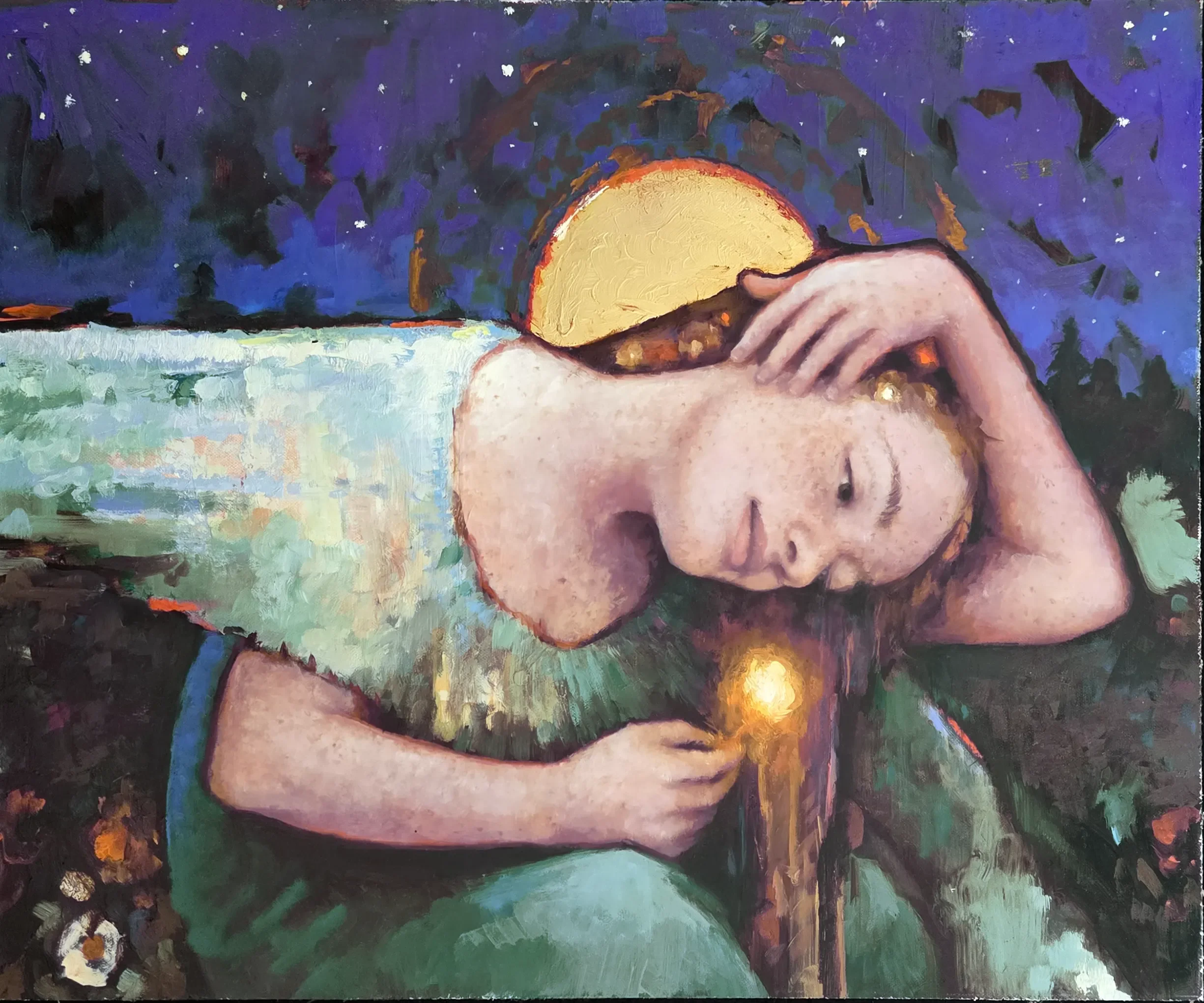
AI functions as a mirror for the artistic vocation, offering this same necessary distance. It is easy to become biased toward the illusion of one’s own "originality" or "importance," staring at a creative identity for so long that the leans and tilts of the ego become invisible. AI reverses the image. By demonstrating that much of what we call "magic" can be mirrored by an algorithm, it provides the shock needed to see the human position accurately. In this reflection, the artist is reminded that they are not the source of the light, but merely a creature tasked with catching it.
Conclusion: Playing in the Creator’s Fields
Ultimately, AI is doing us a favor by showing us that the art was never "ours" to begin with. We have been playing with the raw materials of a creation that has always belonged to God. If we recognize that God is the only true Artist, the threat of AI evaporates. It leaves us with the question: What has God asked me, with all my "meness," to do?
I have found humility and freedom in this conclusion. It strips the burden of unrealistic expectations from my shoulders. It asks me only to use the gifts God has given me. He made my limitations, and He knows that the work is not meant to be anything more than what I am able to make.
For me, this returns us to a state of child-like play. Humility is the true conclusion of the AI experience; it is the gift of being told we aren't the center of the universe, so that we might finally look at the One who is. AI is a mirror. If we look into it and feel "diminished," it is because we have built our identity on the wrong foundations (ego and output). But if we look into it and feel "humility," it is because the mirror has done its job.